Student Success Systems Playbook
The Student Success Systems Playbook supports school teams, district staff, technical assistance intermediaries, and technology solution providers design coherent, integrated systems and supports so all students graduate on time from high school, prepared to flourish in their next steps with future-ready skills. The playbook helps schools and districts bridge the gaps between their human processes and technology systems to effectively use data to improve student outcomes.

What are Student
Success Systems?
These systems leverage data to alert staff when a student may be in danger of falling off-track, help teams identify the root causes of why students are not on track for on-time graduation, facilitate educators with the assignment of evidence-based interventions, and ultimately improve outcomes for students. Well designed student success systems shift teams from reactive responses to proactive support (Balfanz et al., 2019). Student agency and voice lie at the heart of this work, ensuring students share their experiences and collaborate in establishing plans for their success.
Click on each section to learn more
Predictive Indicators
include the data on students’ attendance, behavioral incidents, and course grades, including elements like missing assignments (The GRAD Partnership). These indicators are also sometimes referred to as “the ABC’s” to represent attendance, behavior, and course grades.
Holistic Indicators
is a term used throughout the playbook when referencing data that considers both predictive and well-being indicators.
Well-Being Indicators
consider students’ self-reported sense of agency, belonging and connectedness with their school (The GRAD Partnership).
Student success systems are human-centered, evidence-based frameworks that unite school and district staff in supporting each student to graduate on time, ready to flourish in their next steps (The GRAD Partnership). Unlike standalone early warning indicators (EWIs) or on-track systems (OTS), student success systems integrate technical capabilities of multiple technology solutions with the instructional layers of Multi-Tiered Systems of Support (MTSS) into a comprehensive framework focused on holistic indicators and actionable data cycles (The GRAD Partnership, 2024).
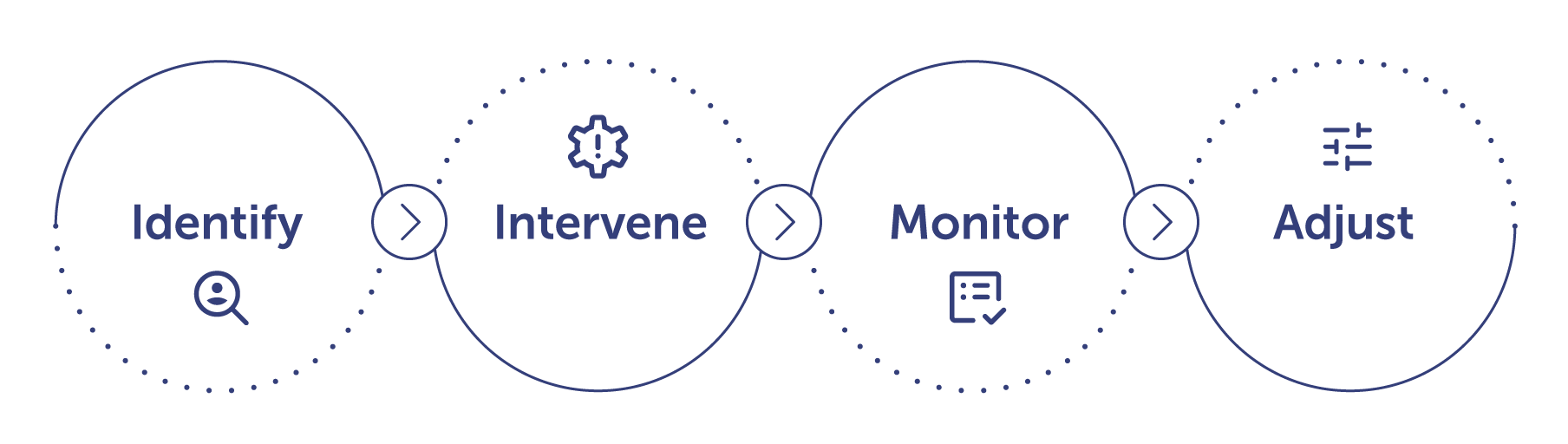
In a well-functioning student success system, data flows through technical systems to ensure each role has the actionable data they need at their fingertips. Using this data, school teams meet with students and caregivers to understand context and co-develop intervention plans to support their growth. District staff pull cross-school data to identify trends and systemic concerns, which may inform policy changes, professional learning, or instructional shifts.
Technology should support the people doing the work – not bury critical information in fragmented systems.

Before School Year
Roster Students, Set Up Gradebooks, Prepare Reports3 Topics

During School Year
Identify At-Risk Students, Center Students and Families in Decisions, Assign Interventions, Monitor Interventions4 Topics

End of School Year
Plan for Continuous Improvement, Wrap Up Data Processes2 Topics
Built to meet you where you are in your school year.
The playbook is designed to support iterative system improvements throughout the school year: each topic balances immediate how-to guidance for day-to-day needs with longer-term strategy and planning resources to help teams collaboratively design systems that work for their context.
An Integrated Ecosystem of Technologies
Individual tools can work for distinctive tasks, but it is challenging to create an ecosystem that seamlessly leverages data across tools to enable student success teams to have the information they need to make informed decisions. Classroom educators mark attendance in one system. A counselor identifies an at-risk student in another system. The intervention plan lives in another. The family notification goes through a fourth. The follow-up data lands back in the first. At every handoff, information can stall, get lost, or arrive too late to matter. These handoffs are the most common breaking point—disconnected systems leave staff to manage what falls into the gaps.
This playbook is designed for those spaces, offering recommendations for integration architecture that creates pipelines for smooth transfer and synchronization of data. The playbook is tool-agnostic, helping teams build a technology ecosystem that best meets their community’s needs—spending less time navigating data architecture and more time supporting students to graduate on time.
Using the Playbook
The playbook is organized around the school year—Before School Year, During School Year, and End of School Year. Pick a time of year and topic to dive in. Each section opens with a checklist to help you assess your current technical and data infrastructure, identify gaps, and find workarounds.
Each section walks through a complete workflow—from human decisions to technical actions to follow-through. Decision points along the way ensure you’re directed to the most relevant information. Jump to topics most pressing for you, or explore holistically to identify systems-level improvements.
Who is this playbook for?
Select a role to see how the playbook supports you.

School-based student success staff
School-based teams, including grade-level teacher teams, counselors, administrators (principals, assistant principals), coaches, and support staff such as reading specialists, multilingual learner specialists, and response to intervention (RTI) specialists.
Staff in these positions can start with the section that matches time of year and process flows that are most relevant to your role and/or local priorities. The infrastructure checklists provide insights into what your current tools can and cannot do. Plays also highlight opportunities to collaborate with caregivers and students directly in designing their intervention plans.


Strategies to Use AI
Emerging technologies, including artificial intelligence (AI), are increasingly embedded in student success system technologies. While many tools have been leveraging machine learning, the advancement of Generative AI (GenAI) and Large Language Models (LLMs) calls for a deeper analysis of when and how schools and districts should utilize these technologies, as well as strategies that enable staff and students to use the tools safely. This playbook outlines tasks AI and technology can automate and support the work of student success teams. It also offers student success teams information on optimal technology use to foster teams’ ability to determine appropriate use of AI for their unique communities.
While AI and automation can save hours of labor for staff, technology can make mistakes. In each play where automation is suggested, the student success team is encouraged to review content for accuracy and usefulness.
Click here to learn how we define AI in this playbook.
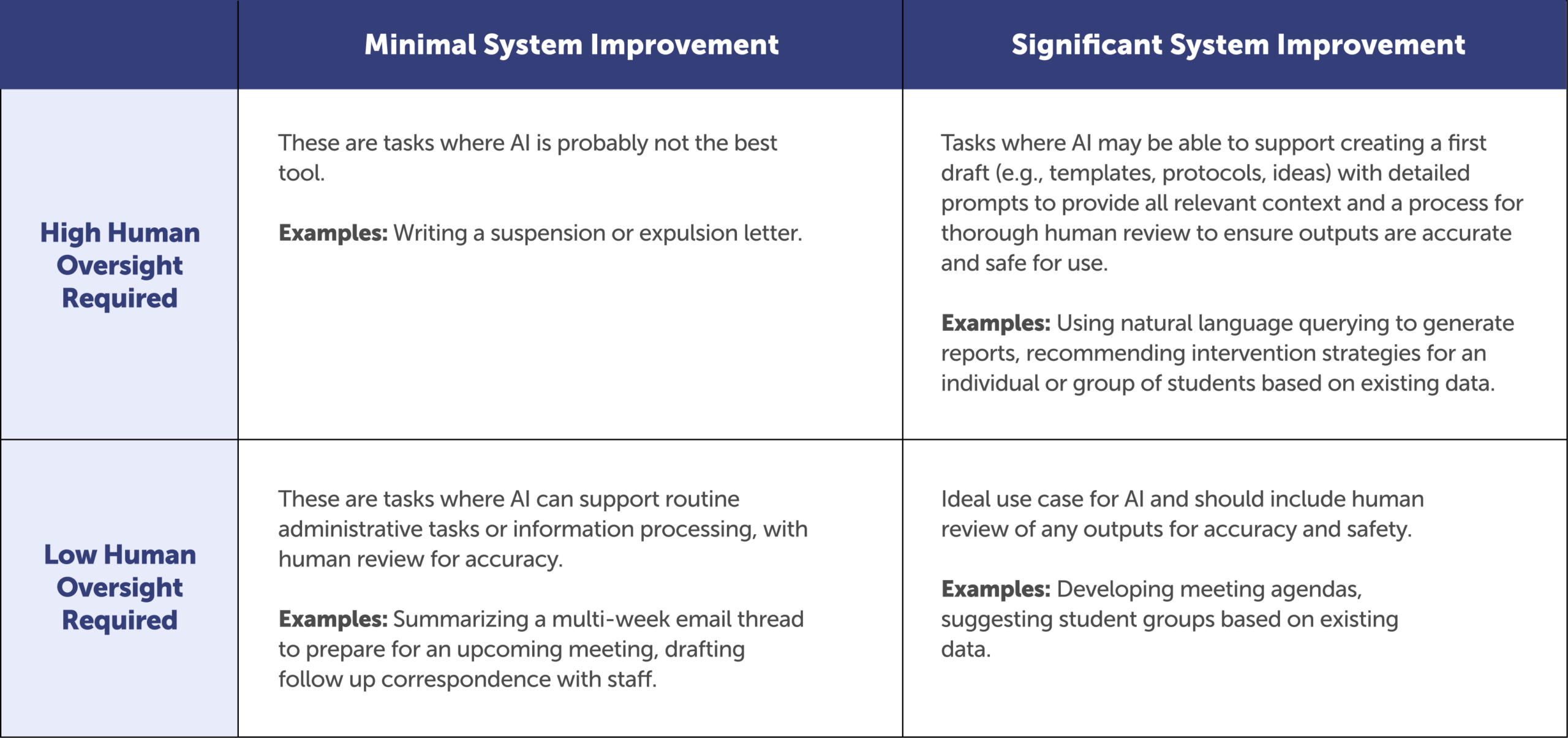
The Risk Analysis for AI in Student Success Systems framework helps student success teams evaluate when the use of AI offers meaningful value to their efforts relative to potential risks and how to evaluate that risk level. This playbook treats AI-generated content, such as intervention recommendations, as an idea generator that supports—but never replaces—human review and judgment. These tools can augment staff capacity but should never be seen as replacing humans. This work relies on relationships and holistic understanding of student needs and appropriate interventions for support.
Risk Analysis for AI in Student Success Systems: A Framework
This framework offers a matrix to consider whether the use of AI-enabled tools will meaningfully streamline workflows or specific tasks for student success teams. For example, if a task requires a minimal amount of human effort and introduces the need for significant human oversight, AI is likely not the right fit. On the other hand, if a task or workflow calls for a significant amount of human effort and the output wouldn’t require substantial human oversight, integrating AI into the workflow is likely worthwhile.
Click here for considerations for AI use and privacy standards.
AI Usage Disclosure
Human teams drove the development of this playbook, including creating the calendar-based orientation, as well as determining the topics and plays described throughout. The team that developed this playbook used AI for specific purposes, described below:
- Gemini Education / AI Pro for Education, Gemini 3 Flash were used to help summarize the key takeaways in spotlights and time of year summaries.
- Claude was used during spring 2026 in early drafts of the playbook introductory language to support the team in determining the right flow of subjects to support users in learning how to most effectively utilize this resource.
- Gemini Education / AI Pro for Education, Gemini 3 Flash were used to help identify provider and partner resources that were then reviewed by humans to confirm accuracy and reputability.
Created in partnership by